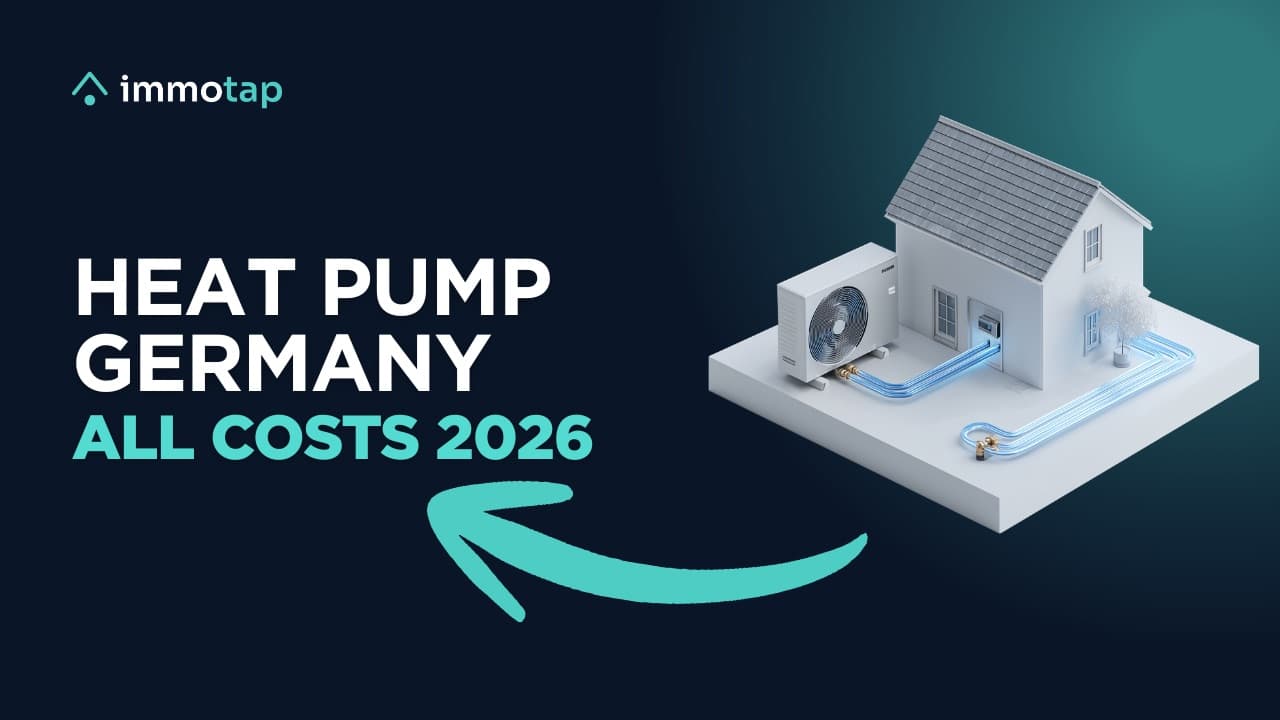
Heat Pump Costs in Germany 2026: Every Number Honestly Broken Down
Purchase, installation, subsidies and running costs of a heat pump at a glance. With an honest comparison against gas and oil, the current 2026 funding rules and practical tips for old and new buildings.
Buying a heat pump sounds like a huge investment at first. You hear numbers like €30,000 and up before a single radiator gets warm. At the same time, manufacturers, energy consultants and politicians promise a golden age: subsidies of up to 70%, low running costs, independence from gas and oil.
How much of that is true? And more to the point: what does a heat pump actually cost in 2026 once you add up every item honestly?
That is exactly what this guide does. No sales brochures, no scare tactics. Just concrete numbers for the purchase, the installation, the subsidies and the running costs. Plus a realistic comparison with gas and oil, a look at the current legal situation under Germany's new building modernisation law, and an honest assessment of who the switch really pays off for in 2026.
How a heat pump works (the short, painless version)
The principle is surprisingly simple. A heat pump works like a fridge, only in reverse. Where the fridge pulls heat out of its interior and releases it outside, a heat pump pulls heat from the environment (air, ground or groundwater) and hands it over to your heating system.
Here is the clever part: for every kilowatt-hour of electricity a heat pump uses, it produces three to five kilowatt-hours of heat. In Germany this ratio is called the Jahresarbeitszahl (JAZ), the seasonal performance factor measured across a full year. A JAZ of 3.5 means one kilowatt-hour of electricity becomes 3.5 kilowatt-hours of heat. That is what makes a heat pump economical despite electricity costing more per unit than gas.
Technically, it runs on a closed circuit filled with a refrigerant that evaporates even at low temperatures. An electric compressor squeezes this gas, which makes its temperature shoot up. A heat exchanger then passes that heat to your home's heating system. The refrigerant cools back down and the cycle starts again.
You don't need to understand the physics in detail. The one thing that matters: the smaller the temperature gap between the heat source and the heating temperature you want, the more efficiently the system runs. That is why well-insulated houses with underfloor heating (low flow temperatures) are ideal, but plenty of older buildings now work well too.
The three types of heat pump compared
Not every heat pump is the same. There are three common types, and they differ a lot in cost, efficiency and effort.
Air-to-water heat pump
The air-to-water heat pump is by far the most popular option in Germany. It uses outdoor air as its heat source, installs without drilling or excavation, and fits almost any building situation.
Total cost including installation runs from €27,000 to €40,000. An outdoor unit goes in the garden or against the wall, an indoor unit in the basement or utility room. Installation usually takes two to three days.
The downside: efficiency drops when it gets very cold outside. On days at minus 15°C the heat pump has to work harder and uses more electricity. For an average German winter that is not a problem. Typical seasonal performance factors land between 3.0 and 4.0.
Since 1 January 2026, tighter noise limits apply for KfW funding (KfW is the state development bank that runs the subsidy programs): the outdoor unit has to sit at least 10 decibels below the legal limits, up from 5 decibels before. This only affects existing buildings, not new builds, and most current models already meet the requirement.
Ground-source heat pump (geothermal)
The ground-source pump taps the steady temperature in the earth. That means either drilling vertical probes 50 to 100 metres deep or laying horizontal collectors about 1.5 metres below the surface.
Total cost runs from €40,000 to €50,000, with the ground works (drilling or excavation) being the biggest extra. Drilling costs €50 to €80 per meter of depth depending on the soil.
The big advantage: ground temperature stays constant at around 10°C all year, whether it is 30°C above or 15°C below outside. That lets ground-source pumps reach higher seasonal performance factors of 3.5 to 5.0, and they work more efficiently in winter than air-source units.
The downside, beyond the higher cost: you need a drilling permit from the lower water authority (Untere Wasserbehörde). Depending on the region, that takes four to twelve weeks. Drilling is not allowed everywhere, for example in water protection zones.
Water-to-water heat pump (groundwater)
The most efficient option, but also the most demanding. It uses the constant temperature of groundwater (8 to 12°C year-round) as its heat source. That requires two wells: an extraction well that pumps the water up and a return well that puts it back.
Total cost runs from €42,000 to €68,000. On top of the drilling you need a water permit and a report on water quality. The groundwater has to meet certain chemical requirements (low iron and manganese) or the system risks corrosion.
Seasonal performance factors of 4.0 to 5.5 are possible. If you have the right plot and the permits, you get the most efficient heat pump there is. In practice this option is fairly rare, because few plots meet the conditions.
Which type suits you?
For the vast majority of single-family homes, the air-to-water heat pump is the right call. It offers the best balance of cost, effort and efficiency. The ground-source pump pays off mainly on larger plots, with high heat demand, and when you want the lowest running costs over the long run. The groundwater pump is a special case for sites with suitable groundwater.
Purchase costs broken down in full
The number you read in an advertising brochure is almost never the number you pay in the end. The real total is made up of several items, and it pays to know each one.
The unit itself
The hardware price of a heat pump runs from €8,000 to €20,000 depending on type and output. A typical air-to-water unit for a single-family home with 8 to 12 kilowatts of heating output costs €10,000 to €16,000 as hardware. Ground-source units usually sit in the same range; the extra money goes into the ground works.
Modern monobloc systems, where the outdoor and indoor units are combined into one, are getting cheaper and easier to install. They need no refrigerant circuit inside the house, which simplifies the installation and saves money.
Pay attention to the refrigerant when you choose a unit. Models that use the natural refrigerant propane (R290) are currently the most future-proof choice. They get an efficiency bonus on the subsidy, and synthetic refrigerants will lose their eligibility over the medium term. R290 models also reach higher flow temperatures of up to 75°C, which makes them suitable for older buildings with conventional radiators.
Installation and assembly
Installation costs run from €4,000 to €8,000 and are similar across all types of heat pump. They cover connecting to the existing heating system, the pipework, the hydraulic balancing and the electrical hookup.
With air-to-water pumps there may be a foundation for the outdoor unit on top (€500 to €1,500). If you are replacing an old heating system, add the cost of removing and disposing of it, roughly €1,500 to €2,500 for an old gas or oil system including tank cleaning.
Tapping the heat source
This is where the types differ the most:
An air-to-water pump has no heat-source costs. The air is simply there.
For a ground-source pump with vertical probes, budget €6,000 to €15,000 for drilling, depending on depth and soil. Horizontal collectors are cheaper (€4,000 to €8,000) but need a correspondingly large garden area.
For a groundwater pump, the two well borings plus the report and the permit add up to €8,000 to €27,000.
Additional components
Buffer tank: €1,500 to €3,000. The buffer tank evens out temperature swings and allows more efficient operation. It is included or recommended in most installations.
Hot-water tank or fresh-water station: €1,500 to €3,000. Needed if the heat pump is also meant to heat your domestic hot water, which is the plan in almost every case.
Electrical work: depending on the state of your existing wiring, expect €500 to €3,000 for a new meter position, a stronger house connection or a separate meter for the heat-pump tariff.
The total bill
For a typical single-family home (120 to 150 square metres of living space), the realistic 2026 total looks like this:
An air-to-water heat pump costs €27,000 to €40,000 all in. The average price for a complete package is around €30,000.
A ground-source pump comes to €40,000 to €50,000.
A groundwater pump runs €42,000 to €68,000.
Watch out with quotes
Between October 2024 and May 2025 the consumer advice centre of Rhineland-Palatinate analysed 160 quotes for air-to-water heat pumps. The results were sobering: total costs ranged from €20,000 to €63,000, only 26% of the quotes were complete, and half left out the electrical work or the foundation. So always insist on a detailed quote and compare at least three specialist firms.
Subsidies in 2026: up to €21,000 in grants
Without the state subsidy, the math would be hard for many households. With it, a heat pump tips clearly into positive territory in most cases, often more strongly than people first assume.
The BEG subsidy through KfW 458
The Federal Funding for Efficient Buildings (Bundesförderung für effiziente Gebäude, BEG) is the central program. KfW handles it under program 458. The maximum grant is 70% of the eligible costs, capped at €30,000 of eligible costs per residential unit. That works out to a maximum grant of €21,000.
The subsidy works like building blocks. You start with the base grant and can stack several bonuses on top:
The base grant is 30%. It is available to every owner who has an eligible heat pump installed.
The climate speed bonus (Klimageschwindigkeitsbonus) is 20%. You get it when you replace a working fossil-fuel heating system, specifically old oil, coal or night-storage heaters, or gas heaters at least 20 years old. This bonus stays at its full value until the end of 2028, then steps down every two years.
The efficiency bonus is 5%. It is granted for heat pumps with a natural refrigerant (for example propane/R290) or for ground-source and groundwater pumps.
The income bonus is 30%. It applies to households with a taxable annual income below €40,000. What counts is the income from two years prior.
Even though the percentages add up to 85% on paper, the total subsidy rate is capped at 70%. And only costs up to €30,000 count. Anything above that you cover yourself in full.
Worked example: what the subsidy looks like
The Müller family owns a single-family home from 1985 and wants to replace their 22-year-old gas heater with an air-to-water heat pump using R290 refrigerant. The unit and installation come to €30,000. The household's taxable income is above €40,000.
The base grant brings 30%, or €9,000. The speed bonus adds 20% (the gas heater is older than 20 years), or €6,000. The efficiency bonus for R290 refrigerant adds another 5%, or €1,500. That comes to 55% in total, or €16,500. The family pays €13,500 themselves.
Had the family's taxable income been below €40,000, the 30% income bonus would have applied too, but the total rate would still be capped at 70%. In that case the maximum grant would be €21,000 and their own share just €9,000.
What you need to know about applying
Mind the order
You have to file the subsidy application before you award the contract to the installer. There is no retroactive funding. You may gather quotes beforehand and sign contracts with a suspensive condition, but the actual commission can only happen after the application is approved.
Processing time at KfW currently runs four to eight weeks. Build that into your schedule.
How long will the subsidy last?
As things stand, the BEG subsidy for replacing a heating system is set to continue until at least 2029. The coalition agreement of the current government provides for sufficient funding up to that point.
Even so, a lot is being rebuilt in 2026. The new government is working on the building modernisation law (Gebäudemodernisierungsgesetz, GMG), which is meant to replace the current GEG and is expected to take effect on 1 July 2026. The base grant for heat pumps stays stable at 30%. The 20% speed bonus stays in place until the end of 2028 and then steps down. The exact shape of the future subsidy will be firmed up over the course of 2026.
So if you are planning a heating replacement anyway, you do well to take the still-high subsidy rates now rather than wait for possibly smaller grants down the line.
Running costs: what a heat pump costs day to day
Purchase price aside, it is the running costs over a 15 to 20 year lifespan that decide whether the investment really pays off. And this is exactly where the heat pump plays to its strengths.
Electricity costs
Electricity is the biggest running item. It depends on three things: your home's heat demand, the heat pump's seasonal performance factor, and the electricity price.
For an average single-family home with 20,000 kilowatt-hours of heat demand per year and an air-to-water pump with a JAZ of 3.5, the power use works out like this: 20,000 divided by 3.5 is around 5,700 kilowatt-hours of electricity per year.
In 2026 you have two options for the electricity itself: household power at roughly 30 to 36 cents per kilowatt-hour, or a special heat-pump tariff at 22 to 26 cents per kilowatt-hour. You get the cheaper tariff if you have a separate meter installed for the heat pump and allow the grid operator to switch the unit off briefly during peak demand.
At 5,700 kilowatt-hours and a heat-pump tariff of 24 cents per kilowatt-hour, you land at electricity costs of around €1,370 per year. On household power it would be about €1,880.
In an unrenovated older building with much higher heat demand (30,000 kilowatt-hours or more), the electricity costs rise accordingly. In the worst case the system can use twice as much power as in a well-insulated house.
Maintenance and upkeep
Heat pumps need far less maintenance than gas or oil heaters. No burner to clean, no chimney sweep to schedule, no filters to swap.
Even so, an annual service by a specialist is worth it. It costs €150 to €400 a year, depending on the unit and the service contract. The check covers the refrigerant, the electronics, the pressures and the system's efficiency.
Since 1 January 2026 there is a legal requirement for an annual leak-tightness check on heat pumps with more than 3 kilograms of refrigerant. In a private single-family home that threshold is rarely reached. A voluntary annual service still makes sense, because it keeps the efficiency up and catches problems early.
The biggest single item over the lifespan is a possible compressor replacement. The compressor is the heart of the system and usually runs reliably for 10 to 15 years. A replacement costs €2,000 to €5,000. Regular servicing extends the compressor's life considerably.
Over a 20-year lifespan you can budget around €9,500 to €10,000 for maintenance and typical repairs combined. That comes to roughly €475 to €500 a year.
Insurance
A heat pump can be covered under your building insurance (Wohngebäudeversicherung). The extra cost is €50 to €100 a year. That covers damage from storm, hail and lightning, and in some policies operating errors or short circuits too. It is not mandatory, but it is sensible protection for an investment of this size.
The annual total
For a typical single-family home with an air-to-water pump, the yearly costs look like this: electricity around €1,200 to €1,500 (on a heat-pump tariff), maintenance €150 to €400, insurance €50 to €100. That comes to roughly €1,400 to €2,000 a year for an average single-family home.
Heat pump versus gas and oil: the honest cost comparison
Now it gets interesting: does it pay off financially? To answer that, we compare the total cost over 20 years.
The starting point
We use a single-family home, 120 square metres of living space, 20,000 kilowatt-hours of heat demand per year. All three systems are newly installed, because the old heater has reached the end of its life.
Gas heating
A new gas condensing boiler costs €8,000 to €14,000 including installation. There is no subsidy for a pure gas heater.
Annual running costs at a gas price of 11 cents per kilowatt-hour (including the 2026 CO₂ tax) come to about €2,400. On top of that: maintenance (€200 to €300), the chimney sweep (€60 to €100) and the unavoidable CO₂ price.
In 2026 the CO₂ price sits at €55 to €65 per tonne. For a home with 20,000 kilowatt-hours of gas demand, that currently means about €250 a year in extra cost, and the trend is clearly upward. From 2028 the European emissions trading scheme for the building sector kicks in too, pushing the cost of fossil fuels further up. Experts expect CO₂ prices of €100 to €250 per tonne by 2030.
And one more point many people miss: the building modernisation law introduces a so-called bio-ramp from 2029. Anyone running a gas heater then has to blend in a growing share of biomethane. Biomethane currently costs two to three times as much as conventional natural gas. Nobody can put an exact figure on what that means for the gas bill long term, but it will not get cheaper.
Oil heating
The purchase costs €10,000 to €16,000. Annual heating costs at an oil price of around €1 per litre come to about €2,000 to €2,500. Add the CO₂ tax, maintenance, the chimney sweep and the fact that from 2045 oil heaters may no longer run on fossil fuels at all.
Heat pump
Purchase of an air-to-water heat pump: €30,000. After the subsidy (55% in the example above): €13,500 of your own money.
Annual running costs: around €1,400 to €1,700 (electricity plus maintenance).
No CO₂ tax, because no fossil fuels are burned directly. No dependence on swings in the gas price. No chimney sweep.
The result over 20 years
Add up every cost over 20 years (purchase, running costs, rising CO₂ prices, maintenance) and the heat pump is the cheapest solution in most scenarios. Even on a conservative estimate, an average household with a heat pump saves €800 to €1,200 a year in running costs compared with a gas heater. Over 20 years that adds up to €16,000 to €24,000.
And that is the conservative version, without rising CO₂ prices and without the extra cost of the bio-ramp from 2029. Factor those in and the heat pump's cost advantage grows even larger.
Heat pumps in older buildings: does it even work?
Probably the most common question homeowners ask. The short answer is yes, in most cases. The longer answer comes with a few caveats.
The myth that underfloor heating is mandatory
The most stubborn myth first: you do not need underfloor heating for a heat pump. One of Germany's largest heating installers reports that nearly 90% of their heat-pump customers in existing buildings use conventional radiators. Only 8% had to swap out individual radiators.
The reason: many radiators in older buildings from the 1960s to 1990s were sized with generous safety margins. Originally designed for flow temperatures of 70 to 90°C, they still deliver 60 to 70% of their rated output at 55°C. In partly renovated buildings that is often enough.
The 55-degree self-test
There is a simple test for whether your house is heat-pump ready. Pick a cold winter day (below 5°C outside). Set your heating to a flow temperature of 55°C. Turn all the thermostats in the living areas fully open. Wait two hours.
Do the rooms reach 20 to 21°C? Then your radiators are sized well enough and a standard heat pump will work without trouble.
Do they only reach 18 to 19°C? Then it is borderline. Individual radiators would need enlarging, which costs an extra €1,500 to €3,000.
Does it stay below 18°C? Then the radiators are too small. Here you need either a full radiator upgrade (€4,000 to €8,000) or a high-temperature heat pump that manages flow temperatures up to 75°C. Modern R290 models can already do this.
When a heat pump in an older building makes no sense
It does not work entirely without limits. In a completely unrenovated older building with a heat demand above 200 kilowatt-hours per square meter per year, it gets difficult. Power use would be so high that the economics suffer. The seasonal performance factor slips below 3.0, and then the heat pump is barely cheaper than gas at current electricity and gas prices.
In cases like that, it pays to invest in insulation first. Just replacing old windows and insulating the roof cuts heat demand by 20 to 30% and makes the heat pump economical.
A long-term Fraunhofer ISE study of 77 existing buildings (built up to 1990) confirms it: even in older buildings, air-to-water pumps reach an average JAZ of 3.4. In the vast majority of cases that is enough for economical operation.
With the energy efficiency quick check you can gauge which energy class your building falls into and which measures would have the biggest effect.
Payback: when do you earn the investment back?
The payback depends heavily on your individual situation. Three scenarios show the range.
Scenario 1: owner-occupier with good subsidy
The heat pump costs €30,000. You get a 55% subsidy (base grant plus speed bonus plus efficiency bonus). Your own share: €13,500. The old gas heater would have had to be replaced anyway. A new gas heater would have cost €10,000 to €12,000. So the real extra cost of the heat pump over a new gas heater is only €1,500 to €3,500. At annual savings of €800 to €1,200, you earn the extra cost back in two to four years.
Scenario 2: owner-occupier with standard subsidy
Same heat pump, but only a 35% subsidy (base grant plus efficiency bonus, no old gas heater over 20 years). Your own share: €19,500. Against a new gas heater that is €7,500 to €9,500 in extra cost. The payback then takes seven to ten years.
Scenario 3: landlord
Landlords get no speed bonus and no income bonus. Typical subsidy: 35%. Own share: €19,500. Since landlords pass heating costs on to tenants, they benefit less directly from the lower running costs. Payback here can take 12 to 17 years. Still, a heat pump raises the property's value and improves the energy certificate, which helps on both renting and resale.
The factor everyone forgets
Most payback calculations compare the heat pump against keeping the old heater running. But that is often a false economy. The old gas or oil heater will have to be replaced at some point regardless. If it is 20 or 25 years old, the swap is due in the next few years whether you like it or not.
So the fair comparison is heat pump versus new gas heater. And there the price gap after the subsidy shrinks to a fraction of the purchase cost, while the savings on running costs keep going for decades.
Heat pump plus solar: the combination that pays off
One of the best investments you can make alongside a heat pump is a solar (photovoltaic) array on the roof. The combination has several advantages.
The most obvious one: you produce some of the electricity for the heat pump yourself. Depending on array size and how well you optimise self-consumption, 25 to 40% of the heat-pump power can come straight from your own roof. That cuts heating costs by a further €300 to €600 a year.
A battery storage unit pushes the self-consumption share higher still. And the feed-in tariff under the renewable energy law (EEG) brings extra income for the surplus power.
The second advantage: you become less exposed to swings in the electricity price. When prices rise, it bothers you less, because a good part of your heating power comes from your own roof.
And the third advantage: the combination speeds up the payback of both systems. The heat pump becomes more economical thanks to the cheaper self-generated power, and the solar array earns a better return through the higher self-consumption (heating power instead of feed-in).
From 2026 this combination gets especially interesting. Several German states already require solar on new builds and during roof renovations. If you have to or want to install a solar array anyway, you can make the most of the synergy with a heat pump.
The building modernisation law 2026: what you need to know
A lot has shifted around Germany's heating law in 2026. On 25 February 2026 the governing coalition presented the key points for the new building modernisation law (Gebäudemodernisierungsgesetz, GMG), which is expected to take effect on 1 July 2026.
What changes
The contested rule that new heaters must run on 65% renewable energy is being scrapped. That means after 1 July 2026 you may again install a pure gas or oil heater. Sections 71 to 71p of the current GEG drop entirely.
The 30-year replacement requirement for old heaters (section 72 GEG) is also set to be scrapped. Existing heaters may keep running regardless of their age.
What stays
The subsidy for switching to renewable heating stays in place. The BEG subsidy (KfW 458) continues until at least 2029. This is an important point: if you install a heat pump now, you do not lose your subsidy just because the law is being loosened.
What is new
From 1 January 2029, new gas and oil heaters will have to run on a growing share of climate-friendly fuels. The starting point is 10% biomethane or bio heating oil, rising in steps through 2040. The exact percentages are not yet fixed.
On top of that, the EU buildings directive (EPBD) has to be written into German law by May 2026. From 2030, strict EU climate rules apply to new builds, which in practice require a heat pump, district heating or biomass. So the brief loosening at the national level may soon be caught up by European rules.
What it means for your decision
On the law alone, you have more freedom in choosing a heater in 2026 than you did in 2024. But the economics have not changed. Rising CO₂ prices, the bio-ramp from 2029 and the lower long-term running costs of a heat pump still argue clearly for the switch. Anyone investing in a new gas heater now has to expect running costs to rise sharply in the coming years and the heater to be shut down by 2045 at the latest.
Price trend: are heat pumps getting cheaper?
Good news for anyone still waiting: heat-pump prices have been falling steadily since 2023. After the price peak during the 2022/2023 energy crisis, when air-to-water pumps were up to 40% more expensive than two years earlier, the market has noticeably eased.
The reasons are varied: higher production capacity at the manufacturers, more competition from European and Asian suppliers, better availability of installers, and more efficient units with lighter builds and modern monobloc systems that simplify the installation.
Germany's heating industry association expects sales of around 410,000 heat pumps in 2026. That is a clear jump from the 260,000 units in 2025 and just 193,000 in 2024. At the same time supply is growing, which keeps stoking the price competition.
By European comparison, heat pumps are still most expensive in Germany. In the UK, comparable systems start at around €14,000, in France at about €18,000. The reasons lie in Germany's stricter building standards, its more varied and often more difficult building stock, and higher labour costs.
The trend for the coming years: heat pumps will keep getting cheaper, but not dramatically. Anyone hoping for a price crash like the one for solar panels will probably be disappointed. The biggest cost factor remains the installation, and labour costs do not fall as fast as hardware prices.
Common mistakes when buying a heat pump
Knowing the pitfalls below saves you a fair bit of hassle and money.
Getting only one quote. Consumer advice centres have shown that quotes for identical work can vary by up to €40,000. Get at least three quotes from different specialist firms and compare them item by item.
Forgetting the electrical work. Many quotes leave out the cost of a new meter position, adjusting the wiring or the separate heat-pump meter. Ask about it explicitly.
Skipping the heat-load calculation. A correctly sized heat pump runs more efficiently. Too big and it cycles constantly (switching on and off), which raises power use and shortens its life. Too small and it cannot keep up on cold days.
Filing the subsidy application too late. As mentioned: the application has to reach KfW before you award the contract. Forget that and you lose thousands of euros in funding.
Leaving out the hydraulic balancing. Hydraulic balancing makes sure every radiator gets an even supply. Without it the heat pump runs less efficiently, because some rooms are over-supplied and others under-supplied. The balancing costs around €500 to €1,000 and is mandatory anyway for a subsidized heating replacement.
Not signing up for a heat-pump tariff. The price gap between household power and a heat-pump tariff adds up to several thousand euros over the lifespan. A separate meter costs a few hundred euros once and almost always pays off.
Checklist: how to approach a heat-pump purchase the right way
Step one: Check your heat demand. Look at your energy certificate or your last heating bill. How many kilowatt-hours does your house use per year?
Step two: Run the 55-degree self-test. Does your house work at a 55°C flow temperature? Then nothing stands in the way of efficient operation.
Step three: Clarify your subsidy situation. Which bonuses are you entitled to? How high is your taxable income? How old is your current heater?
Step four: Get at least three quotes. Make sure they are complete, including the wiring, the foundation, removing the old heater and the hydraulic balancing.
Step five: File the KfW application before awarding the contract. Allow four to eight weeks of processing time.
Step six: Compare heat-pump tariffs. A separate meter saves a lot over the long run.
Step seven: Plan for the combination with solar. Even if you install the array later, the heat pump should be prepared for the combination from the start.
With the energy efficiency quick check you get a first read on which energy class your building falls into and which efficiency measures make sense.
Frequently asked questions (FAQ)
What does a heat pump cost in full in 2026?
An air-to-water heat pump costs €27,000 to €40,000 including installation. After the state subsidy (30 to 70%), your own share comes to €9,000 to €19,500.
How high are a heat pump's electricity costs per year?
For an average single-family home with 20,000 kilowatt-hours of heat demand, electricity costs run around €1,200 to €1,500 a year (on a heat-pump tariff). With a solar array the costs can be cut further.
Does a heat pump work in an older building?
Yes, in most existing buildings an air-to-water heat pump works without trouble. Modern high-temperature models reach flow temperatures up to 75°C and work with conventional radiators too. The 55-degree self-test shows whether your house is suitable.
How long does a heat pump last?
The lifespan is 15 to 25 years. Ground-source pumps often last even longer. Regular servicing (€150 to €400 a year) secures a long life and efficient operation.
Is there still a subsidy for heat pumps in 2026?
Yes. The BEG subsidy through KfW 458 continues. The base grant is 30%, and with various bonuses up to 70% is possible. Under the coalition agreement the subsidy is set to remain until at least 2029.
What changes under the building modernisation law?
The 65% renewable-energy requirement for new heaters is dropped. Gas and oil heaters may be installed again, though with a bio-ramp from 2029. The subsidy for heat pumps stays in place.
When does a heat pump pay off against gas?
Compared with a new gas heater and accounting for the subsidy, the payback is two to ten years, depending on the subsidy level and your individual heat demand. Over 20 years a heat pump saves €16,000 to €24,000 in running costs against gas.
Do I need underfloor heating for a heat pump?
No. Underfloor heating is not a must. Around 90% of heat-pump customers in existing buildings use conventional radiators. What matters is that the radiators are sized large enough and the flow temperature ideally stays below 55°C.
Is a heat pump loud?
Modern air-to-water pumps reach noise levels of 35 to 50 decibels, comparable to a quiet conversation or a fridge. For KfW funding, units have had to sit at least 10 decibels below the legal limits since 2026. When siting the unit, leave enough distance to neighbouring plots.
Glossary of abbreviations
| Abbreviation | Meaning |
|---|---|
| BEG | Bundesförderung für effiziente Gebäude (Federal Funding for Efficient Buildings) |
| CO₂KostAufG | Kohlendioxidkostenaufteilungsgesetz (law splitting CO₂ costs between landlord and tenant) |
| COP | Coefficient of Performance (efficiency at a single moment) |
| EEG | Erneuerbare-Energien-Gesetz (Renewable Energy Act) |
| EPBD | Energy Performance of Buildings Directive (EU buildings directive) |
| GEG | Gebäudeenergiegesetz (Building Energy Act) |
| GMG | Gebäudemodernisierungsgesetz (building modernisation law, successor to the GEG, expected from July 2026) |
| JAZ | Jahresarbeitszahl (seasonal performance factor across a full year) |
| KfW | Kreditanstalt für Wiederaufbau (state development bank) |
| R290 | Propane (natural refrigerant) |
| SG Ready | Smart Grid Ready (interface for grid-friendly operation) |
This guide is for general information and does not replace individual advice from an energy consultant, heating installer or subsidy advisor. All information without guarantee, as of March 2026.
More articles

Buying a House in Germany: The Complete Guide from First Idea to Handover of Keys
Step by step to your own home: budget, closing costs, financing, the purchase contract, handover and renovation obligations. The complete guide for house buyers in Germany.
 immotapFebruary 27